Showing posts with label BBC. Show all posts

Thursday, 31 March 2011

Round Stones


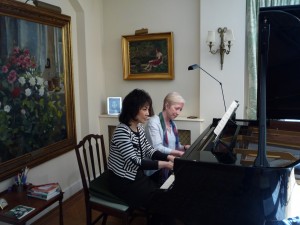
When the Japanese pianist, Noriko Ogawa, read Out of Silence by Susan Tomes, she was so impressed she decided to translate it into her own language. Earlier this week, the two pianists came together to discuss the challenges of translating a book like this into Japanese (the various nuances of ‘practice’ in Japanese, did Susan Tomes write in a woman’s voice or a man’s voice, and so on). Their meeting was recorded and broadcast by BBC Radio 4 on their Women’s Hour programme. Here, by way of a reminder, is one of Noriko Ogawa’s favourite pieces from the book. Perhaps it is a cliché to suggest that the Zen calm of this extract appealed to her.

Back in the days when I used to play for the string masterclasses at Prussia Cove, I developed the habit of going for a walk along the beach by myself after the classes to dispel the tensions of the day. My job was to play the piano for the violinists, viola players or cellists who were having a lesson. The lessons took place in front of a roomful of other gifted students and visiting teachers from all over the world, so the atmosphere was always intense and the stakes high. I wasn’t having a lesson myself, but this didn’t stop certain teachers from including me in their personal criticisms and tantrums, and I sometimes needed to remind myself afterwards that there were things in life other than music.

I walked slowly along the beach, looking for interesting stones. My method was not to look for anything consciously, but just sweep the beach with my gaze and let the stones call to me. I took them back to my room and kept them on the windowsill as talismans, though I usually liberated them back to the beach before I went home. As I walked on the beach, waiting for ‘interesting’ ones to present themselves, I realised that I was always drawn to stones which were smooth and round. This may not be most people’s idea of interesting stones, but it’s mine. I am fascinated by the thought of the multiple forces of wind and water which have to work on a rough piece of rock for years and years to convert it into something smooth and round. Such tremendous forces from so many different directions: what are the chances of them making something round? Far easier to imagine how the clash of asymmetrical forces could produce jagged, dramatic shapes with attention-seeking personalities. There were plenty of those theatrical stones on the beach, but I passed by on another track. I see the round stones as survivors of a long process of buffeting. They hold more secrets.

Out of Silence by Susan Tomes is available from all good booksellers. Her earlier book, Beyond the Notes, largely concerning her time with Domus, remains in print. Both are published by the Boydell Press.

Thursday, 27 May 2010

Remembering Fernande Kaeser

Among the many pleasures of Leo Black’s new book, BBC Music in the Glock Era and After, are his short portraits of some of the artists and performers he knew during his years with the Corporation. Meet Luigi Dallapiccola and Hans Eisler, Janet Baker and Norma Burrowes, Elisabeth Schwarzkopf and many others. This post, however, remembers someone that Black describes as ‘one of the great musicians in my life’:

The encomium ‘made in Switzerland’ comes my way but rarely, implying as it does the perfect execution of a Martina Hingis or a Roger Federer. Very early in my BBC time William Glock asked me to look in on the Festival Hall rehearsal of an American conductor who’d written to him, and say what I thought. I arrived while an orchestral work was being rehearsed (even a week later I couldn’t have told you what it was, though I seem to remember that the second half consisted of Beethoven’s Seventh Symphony). Things changed drastically for the better when a small, dark-haired young woman walked on, sat down at the keyboard, and conjured up the opening chords of Beethoven’s Fourth Piano Concerto. The rest of the morning was magic. I’d seldom or never heard piano-playing of such concentrated beauty and communicative power; the passion with which this apparent Swiss mouse delivered the fortissimo version of the chords at the first movement’s recapitulation is with me still. For Fernande Kaeser music was, in the immortal words of another William (Bill Shankly, Manager Liverpool Football Club), “not a matter of life and death but more important than that”.

Here, clearly, was an artist I just had to work with. She went on to continue a reasonable career on both sides of the Atlantic, but in the course of time it became a career teaching rather than performing. I discovered much later, after dropping some dismissive remark about competitions, that in the early 1950s she’d won the top piano prize at the Geneva International, one of the relatively few such contests which really counted, long before the time when you absolutely have to have won somewhere, and preferably somewhere else too. That she’d been in good company emerged even later during a brief acquaintanceship with Jennifer Vyvyan’s son: he dug out a programme that showed Fernande as the year’s successful pianist, alongside two major singers, his mother and the American soprano Teresa Stich-Randall. They’d shared the top vocal prize (which must have been too small to reward suitably two such talents): I still remember hearing about it at the time, and the way in which the name Jennifer Vyvyan immediately became one to watch out for. She was in fact one of the greatest singers Britain has produced, and I regret having worked with her only once, in a programme of French songs. Not being British, the piano-prizewinner didn’t get the same attention here. Fernande was the last pupil of Dinu Lipatti and had in her tenderest years received memorable advice from Clara Haskil; but despite Geneva the top agents weren’t interested, which even then was an inhibitor of really widespread success.

Our BBC collaborations were few and far between, for she spent a lot of her time teaching in the USA, but they always produced something of lasting interest. The pearl among them was a programme with two sets of fairly obscure variations, Bach’s Aria variata alla maniera Italiana and Mozart’s on a theme by Duport. I count that as the most beautiful programme for which I was responsible in my twenty-eight BBC years. Basil Lam summed up her special quality when I played him something she’d recorded, saying “Well, it isn’t fair is it, you give her a better piano than anyone else”. Certainly her ability to find the poetry in any given instrument was phenomenal; it came partly from careful preparation, sometimes involving all the spare studio time available for a couple of days before the show, as well as a pianistic talent of rare quality.

Fernande’s career was never glamorous, which is in part attributable to her own total distaste for the kind of ‘glamour’ that attracts attention regardless of talent, and also, perhaps, to that responsible attitude to preparation. On her one and only visit to our house, near the end of her life, she told of playing chamber music with a group. It was a pleasant enough evening, but one that ended in bathos when the chaps said “Right, the concert’s in a fortnight’s time.” “Not with me it isn’t,” said Fernande, and that was the end of the matter.

There was certainly nothing missing on the musical side, as I realized when I discovered in the Austrian Radio’s index of recordings a performance by her of the notoriously difficult Tippett Piano Concerto. Its designated first performer had withdrawn, declaring it unplayable; the veteran virtuoso Louis Kentner had then stepped in and proved him wrong; and here was five-foot two Fernande taking it on! Poor health meant an early end to her work, and she died too young: I count her one of the great musicians in my life.

BBC Music on the Glock Era and After is published by Plumbago Books and is available in both hardcover and paperback from booksellers of repute.

Friday, 9 May 2008

Lunch at La Pietra


Peter Dickinson’s latest book, Lord Berners: Composer Writer Painter will be published in September. It is a refreshingly new documentary approach to a unique personality - interviews with leading figures and contemporaries who knew Berners and his work. Here Peter Dickinson recalls visiting Harold Acton in Florence.

In 1983 I made a BBC Radio 3 documentary about Lord Berners to mark his centenary – the interviews will be printed in full in my book. I also put on concerts at the Wigmore Hall and elsewhere with my sister Meriel Dickinson singing the songs and Timothy West giving readings from Berners’ novels and autobiography. One of the most fascinating interview subjects was Sir Harold Acton and the BBC producer, Arthur Johnson, and I went to Florence to see him. We joined other guests for lunch afterwards – the waiters wore white gloves – and then looked round the formal gardens lined by box hedges and featuring sculptured figures along vistas.

Acton’s family had had connections with Italy for several generations and it was his father who bought La Pietra around 1900. The villa, approached through a long drive of cypresses, became legendary for its art collection, scrupulously maintained by Acton following the death of his father in 1953 and eventually left to New York University.

Acton’s contemporaries at Eton included Lord David Cecil (also interviewed at length in my book) and at Oxford he was of the same generation as Evelyn Waugh, Graham Greene and Anthony Powell. He wrote poetry, novels, a biography of The Last Medici, and studies of the Bourbons of Naples.

Acton spent most of the 1930s in China, lecturing at Peking National University and after the war he wrote Memoirs of an Aesthete and More Memoirs of an Aesthete. He was knighted in 1974 for services to the British Institute and to Anglo-Italian relations. His recreations listed in Who’s Who include ‘hunting the Philistines’. I asked him when he first encountered Lord Berners (he was the only person I met who could go back to World War I):

“I met him when I was quite a young boy really. I had just gone to Eton and I was visiting in Rome with my father who took me to see Berners’ studio, which was full of modern paintings and there were huge bowls of coloured water with tin goldfish in them, which used to stir. There were all sorts of gadgets such as marionettes and peculiar things that struck a boy as extremely unusual. He himself was never very talkative. He just waited for one’s comments. You could see he was anxious to surprise one. There were hidden jokes: something might pop out of a cushion or anything. It had a curious atmosphere of its own which he had created.

One of the most noticeable things was a large photograph of the Marchesa Casati, a very striking lady much painted by all the well-known painters of the period. She was a close friend of his, also very interested in eccentric things. She had Moorish servants feeding leopards from her house - very strange.

He was then in the British Embassy called Gerald Tyrwhitt as Honorary Attaché. That’s when I first met him. And I saw him fairly often when he came to Florence in his huge Rolls Royce with a porcelain turtle in it and a little spinet which he used to play while being driven.”

That was the legend – and legends persist because people often prefer them to the facts. But my book reveals that the instrument was a clavichord kept in a compartment under the front seat.

Monday, 28 January 2008

Rubbra at the BBC


This month we will publish a new book by Leo Black, Edmund Rubbra: Symphonist. Black, a pupil of Rubbra in the 1950s, presents the first full-scale study of his symphonies for fifteen years and a biographical sketch throws light on legends about the BBC and Rubbra as well as the vexed question of the composer’s mysticism. In this short piece, Leo Black reflects on tutorials with Rubbra and programming his music at the BBC:


Harmony and counterpoint “tutes” with Edmund Rubbra at Oxford half a century ago were decorous affairs. In a quite small room just on the left as you went into the Music Faculty building on Holywell Street, he would look through the exercises one had prepared during the week, and home in on anything that gave him cause to enquire, as a totally rhetorical question, "Did you really hear that in your head?" He was in his earliest fifties, robust but gentle, with a well-tended goatee beard, and his manner radiated an inner calm; to those on no kind of personal terms, with no inkling of his private life, it was convincing. Had we only known it, his marriage of the previous twenty years was even then breaking up in quite spectacular fashion, set against which he'd become converted to Roman Catholicism a few years before. Needs must when the devil… whoops, not quite the right cliché.

A decade later, there I was working in the Music Programmes Department of BBC Radio at a time when William Glock, brought in as Controller, Music, had diagnosed a chronic anaemia in the matter of red blood from abroad. I'd been working for the leading purveyor of the newest noises, Universal Edition Vienna, so I was in the shop window and found myself recruited to up the Stockhausen Quota. This and that piece of manifest nonsense soon had me disillusioned with my place alongside the avant-garde, where there seemed to be very little red blood and a lot of what the great contemporary master of insult, Kingsley Amis, called “pee-talking”, but the radio output was large enough to let a long-standing love of the First Viennese School and a feeling for the best products of the Second earn me my keep for many years still. Someone less on my mind than most was my old tutor, for whom I did regrettably little (another Oxford ex-pupil, Robert Layton, proved more loyal). That's a debt I hope my new book will help to repay, though in it I do have to pour a little cold water on the more lurid rumours of a Glock-led conspiracy to suppress the music of so well-established and major a composer. As he said, “in 1963 there were 26 broadcasts of Rubbra's music, and one of Stockhausen's”.

The main thing is that the past few years' vigorous catch-up course in Rubbra's music has confirmed to me how right Vaughan Williams was when he named Rubbra as his principal successor in the role of English symphonist. I stand by my title!