Showing posts with label Out of Silence. Show all posts

Thursday, 31 March 2011

Round Stones


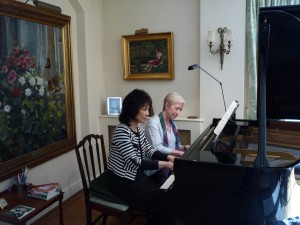
When the Japanese pianist, Noriko Ogawa, read Out of Silence by Susan Tomes, she was so impressed she decided to translate it into her own language. Earlier this week, the two pianists came together to discuss the challenges of translating a book like this into Japanese (the various nuances of ‘practice’ in Japanese, did Susan Tomes write in a woman’s voice or a man’s voice, and so on). Their meeting was recorded and broadcast by BBC Radio 4 on their Women’s Hour programme. Here, by way of a reminder, is one of Noriko Ogawa’s favourite pieces from the book. Perhaps it is a cliché to suggest that the Zen calm of this extract appealed to her.

Back in the days when I used to play for the string masterclasses at Prussia Cove, I developed the habit of going for a walk along the beach by myself after the classes to dispel the tensions of the day. My job was to play the piano for the violinists, viola players or cellists who were having a lesson. The lessons took place in front of a roomful of other gifted students and visiting teachers from all over the world, so the atmosphere was always intense and the stakes high. I wasn’t having a lesson myself, but this didn’t stop certain teachers from including me in their personal criticisms and tantrums, and I sometimes needed to remind myself afterwards that there were things in life other than music.

I walked slowly along the beach, looking for interesting stones. My method was not to look for anything consciously, but just sweep the beach with my gaze and let the stones call to me. I took them back to my room and kept them on the windowsill as talismans, though I usually liberated them back to the beach before I went home. As I walked on the beach, waiting for ‘interesting’ ones to present themselves, I realised that I was always drawn to stones which were smooth and round. This may not be most people’s idea of interesting stones, but it’s mine. I am fascinated by the thought of the multiple forces of wind and water which have to work on a rough piece of rock for years and years to convert it into something smooth and round. Such tremendous forces from so many different directions: what are the chances of them making something round? Far easier to imagine how the clash of asymmetrical forces could produce jagged, dramatic shapes with attention-seeking personalities. There were plenty of those theatrical stones on the beach, but I passed by on another track. I see the round stones as survivors of a long process of buffeting. They hold more secrets.

Out of Silence by Susan Tomes is available from all good booksellers. Her earlier book, Beyond the Notes, largely concerning her time with Domus, remains in print. Both are published by the Boydell Press.

Friday, 12 March 2010

Artist Unknown

A friend tells me that she’s just bought the Beethoven piano trios on CD, so naturally I ask, ‘Who’s playing them?’ ‘Oh!’ she says. ‘No idea. I’m afraid I didn’t look at the names of the players.’ Why do people seem to think the performer is irrelevant?

A relative of mine recently confessed that although he was becoming quite familiar with the classics of the piano trio repertoire, he doubted whether he would be ever able to discern any difference between performances of those works by different groups. When I express dismay, he says, ‘But surely there can’t be much difference between top-level musicians playing the same works. Aren’t you all aiming at the same result?’ By that I suppose he meant that all musicians are trying to arrive at a perfect realisation of that holy text, the musical score. But there’s another way of looking at it, one expressed beautifully by musicologist Christopher Small when he pointed out that one might as well turn this perception on its head and consider that it’s the job of composers to give musicians something to play. At the end of the day, you can’t hear music unless it is played, and it is the character of the playing which most impacts on listeners at the moment of performance. Personally, I wouldn’t put the performance above the score in order of importance, but I do think the performance is crucial. Well, I would think so, wouldn’t I? But as well as knowing that a good piece can be ruined by a bad performance, and that a bad piece can be greatly enhanced by a good performance, I also truly believe that a great performance can bring a good piece to a new level.

I remember hearing Italian soprano Cecilia Bartoli in a programme of rather trivial Italian arias of the baroque and classical periods. Any thought of the music’s triviality was however completely driven away by the energy and commitment she gave to it, performing it as though she thought it was utterly fascinating. I remember thinking that it was an object lesson in how to perform second-rate music, and in fact I’ve learned from her example.

But even music of the finest quality can reveal new aspects of itself and even become transcendent in a fabulous performance. My husband Bob still remembers his awe on hearing Carlos Kleiber conduct Verdi’s Otello at Covent Garden in the 1970s. It’s an opera he’d previously heard in fine performances with other singers and other conductors. However, in Kleiber’s hands the opera suddenly struck him as a miracle of expressive coherence in a wholly unexpected way. Even though he knew the music very well, he was so gripped by the performance that he remained glued to his seat long after the performance had ended, unwilling to break the atmosphere. Later on, he heard that Bernard Haitink had attended the same performance with a fellow conductor and had said to his companion, ‘Well, that was the finest evening in the opera house that you or I will ever experience.’ Yet what remained for Bob was not the sensation of Kleiber’s personality but the conviction that Verdi’s Otello was even better than he had realised. When he could bear to listen to it again, performed by other people in later years, the effect was not the same. He realised that the alchemy at Covent Garden had been created by music brought to boiling point by particular musicians.

Of course, this kind of experience is not confined to music. How many schoolchildren, bored and irritated by having to study Shakespeare, conclude that there’s nothing in it for them until one day they get the opportunity to see a really good performance of one of his plays, when all of a sudden a door is kicked open in their minds.

This is an extract from Out of Silence by Susan Tomes, scheduled for publication later this month. It is a diary of a year in her life as a performer. Taking as its inspiration Schumann's remark that ‘I am affected by everything that goes on in the world, and I think it all over in my own way’, it aims to show how a working musician mulls over and draws energy from the events of everyday life.

Tuesday, 9 February 2010

Inner Voices


Some years ago we published an account of life on the road with a chamber music ensemble: Beyond the Notes. Pianist Susan Tomes’ diary of her time with Domus and the beginnings of the Florestan Trio captured the imagination of music lovers and critics alike, and remains essential reading for young musicians taking their first steps in the classical music business. Next month the Boydell Press will publish a new book by the same author, Out of Silence. Taking as its inspiration Schumann's remark that 'I am affected by everything that goes on in the world, and I think it all over in my own way', it aims to show how a working musician mulls over and draws energy from the events of everyday life.

Over the coming weeks we’ll be posting some short extracts from
Out of Silence, beginning with this piece about inner voices in music, specifically in chamber music:


After many years of being an amateur wind player, my brother-in-law has given up the French horn and has taken up the viola instead. He feels that playing the horn is getting too strenuous for his lips. I asked him whether he didn’t feel this was his opportunity to grab the limelight and take up the violin instead, to have the experience of playing the top line? Or the double bass, to see what it’s like at the bottom? He says that having played the French horn for years in wind quintets and orchestras, he finds he has become attached to the role of being a middle voice, and wants to continue in this persona, so he is naturally drawn to the viola. Just as he sees the horn as the mediator of the brass section, he sees the viola as the voice of reason in the strings, rarely getting to sing a glamorous aria, but playing a very important stabilising role. He identifies with this role. We agree that an interest in inner voices is one which marks out a certain kind of musician. There’s often so much focus on the leading voice, the top line, the melody instrument, the solo part, and so on, but just as much if not more meaning emanates from the middle voices, often not sufficiently heard or understood. Thank goodness there are people who feel genuinely drawn to playing those middle parts, who see themselves as the binding agent, like eggs in a cake mixture.


There’s something in common with the chamber musician here, though a love of inner voices doesn’t quite sum up the chamber musician’s passion. For us, it’s a little more complicated than that. Chamber players love the diversity of roles they have to play, sometimes being the leader, sometimes a companion, sometimes a supporter or a commentator. They love to find out when they are meant to surge forward, when to step into the limelight, when to comment from the wings, when to contradict, and when to offer another, perhaps more persuasive point of view. They understand that it is a process of layering, and that they must be prepared to explore all the layers. I don’t know whether such people are drawn to chamber music because they are open-minded and naturally good listeners, or whether they acquire a tolerant approach along the way, but one thing’s for sure: you won’t get much out of chamber music unless you genuinely have a live-and-let-live attitude. If you’re convinced your own part is the most important all the time, you’d be better off sticking to solo concertos. In chamber music, even the naturally more dominant instruments, such as the piano (or should I say, even the naturally more dominant instrumentalists, like pianists) still have to weave their way in and out of the plot. Chamber music at its best is a vision of the ideal society, where people converse, exchange and are sensitive to one another, respecting one another’s territories. It seems to me good preparation for life in a free society.


Out of Silence by Susan Tomes will be published by the Boydell Press next month.